
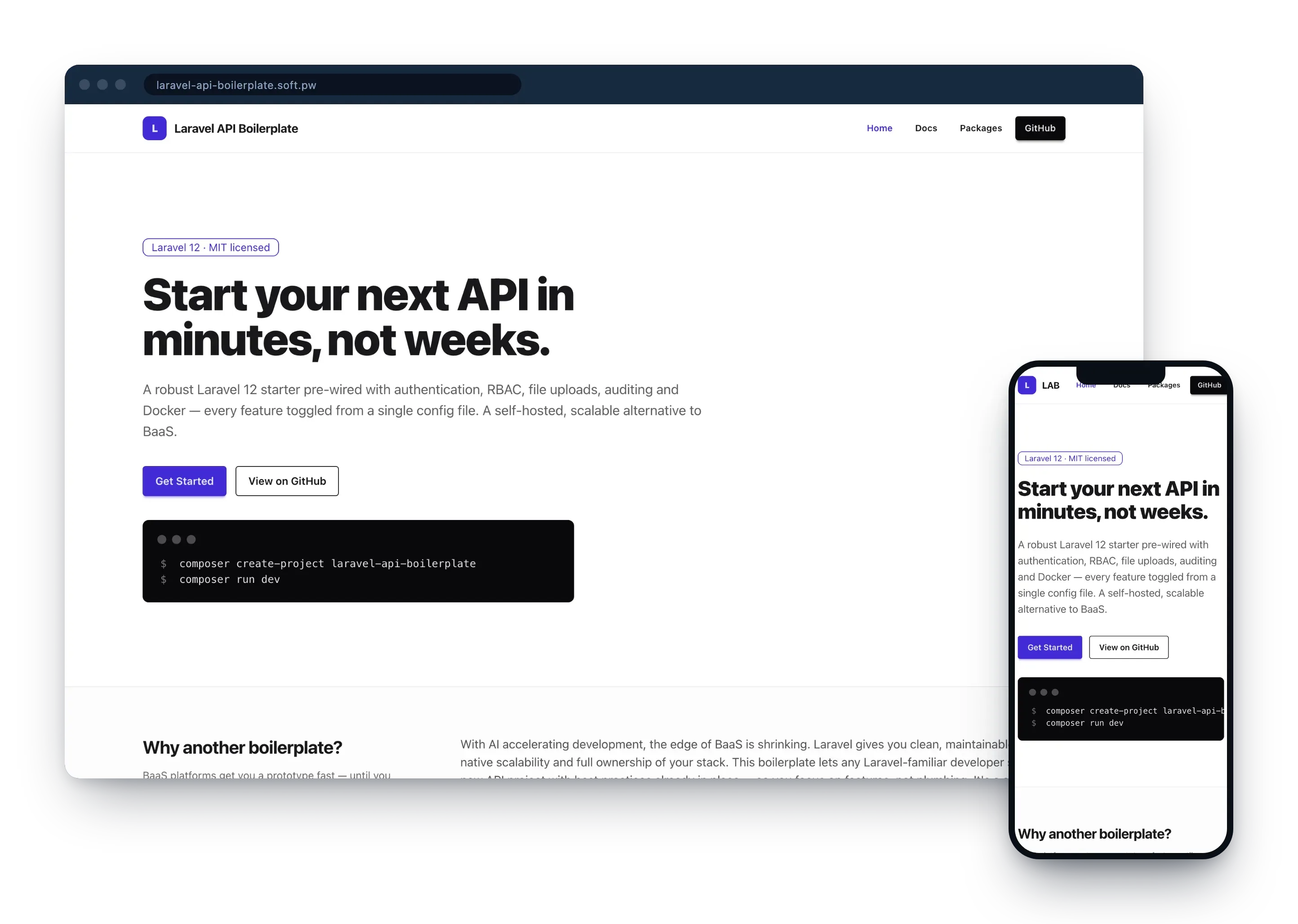
Overview
Laravel API Boilerplate is an open-source starter kit for building production-ready RESTful APIs on Laravel 12. It packages the baseline pieces that most backend products need, including authentication, role-based access control, file uploads, auditing, rate limiting, Docker, generated API documentation, and a consistent response envelope.
This is a self-directed developer tool that I planned, designed, implemented, documented, deployed, and maintain. Its goal is to turn repeatable backend setup work into a configurable foundation that can be reused across SaaS products, internal tools, and API-first services.
Product Architecture
- Laravel 12 API foundation - The project provides a REST-oriented backend structure with routes, controllers, middleware, policies, resources, data objects, and tests organized around API product work instead of a generic demo app.
- Config-first feature toggles - Core behavior is designed to be enabled or disabled through configuration, keeping the starter adaptable without requiring consumers to delete large sections of code.
- Authentication layer - Laravel Sanctum supports token-based API access, while passwordless OTP and social login paths give product teams multiple onboarding options.
- Authorization model - Laratrust powers role and permission checks so applications can start with RBAC instead of adding access control after business features already exist.
- Consistent API contract - Responses use a standard envelope for success, errors, pagination, and validation feedback, making client integration easier across web, mobile, and third-party consumers.
- File and audit services - Upload handling, temporary file lifecycle, and append-only audit logging are included as first-class backend concerns.
- Dockerized development stack - The stack is prepared for local development with containerized services such as PostgreSQL and Redis, reducing setup drift between machines.
- Documentation workflow - Scribe-generated API documentation gives the project a public developer-facing surface and keeps usage guidance close to the implemented endpoints.
- AI-ready maintenance context - Project rules and Laravel Boost MCP support help keep future implementation work aligned with the starter’s conventions.
Key Features
- Production-oriented defaults - API authentication, RBAC, rate limits, file uploads, audit records, validation, and documentation are included from the start.
- Self-hosted BaaS alternative - The starter targets teams that want reusable backend primitives without depending on a hosted backend-as-a-service platform.
- Developer documentation - Public docs explain installation, configuration, authentication, files, and API behavior for faster adoption.
- Reusable API base - The structure is suitable for launching new Laravel API products, internal admin backends, SaaS services, and integration-first systems.